
Digital Services for the Italian Public Administration
Designing a unified, citizen-friendly experience for government digital services
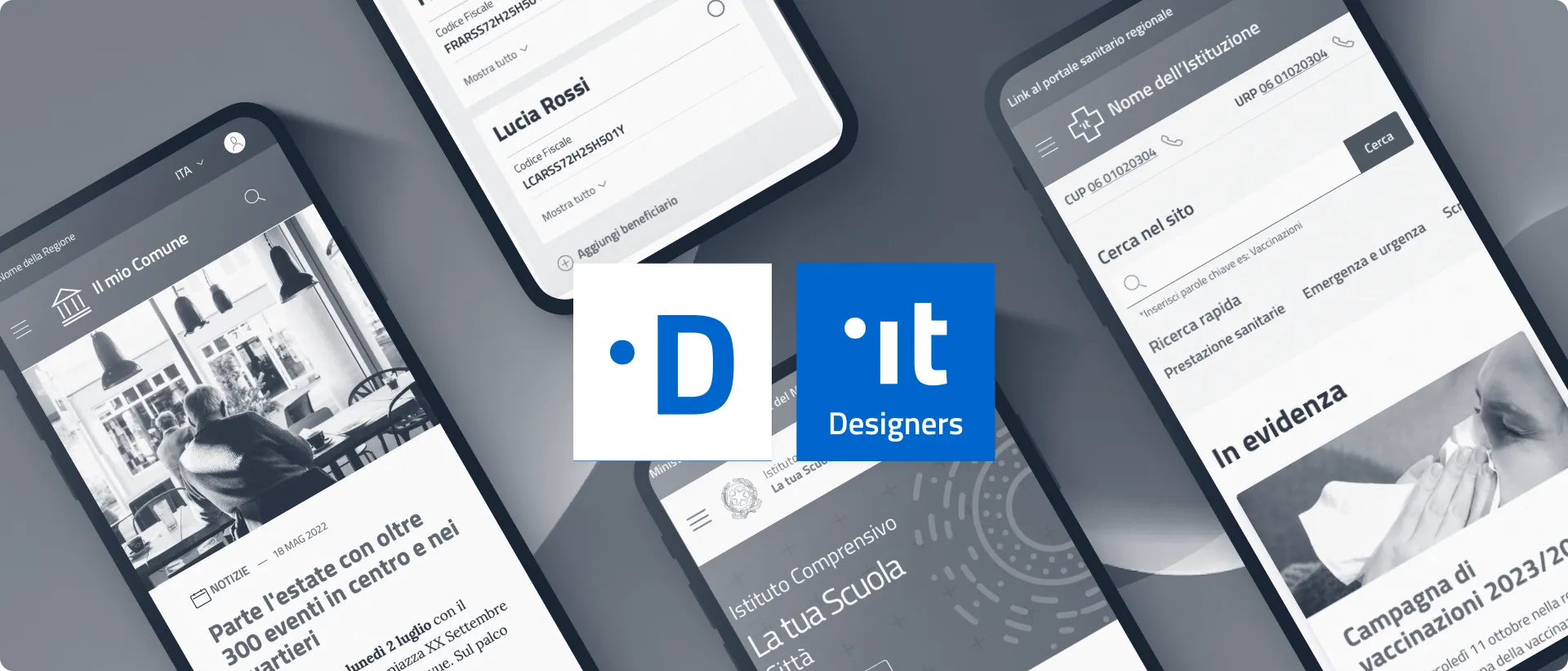
At the Italian Department for Digital Transformation, I worked on designing scalable models and templates for digital services used by Italian citizens — from municipality websites to national health portals. The work involved defining UX patterns, building reusable templates, and ensuring consistency across the entire public administration digital ecosystem.
The challenge
Italy has over 7,700 municipalities, each with a website serving local citizens for services like booking appointments, paying fines, or accessing local documents. Most of these sites were outdated, inconsistent, and difficult to use — especially for elderly or less digitally-literate citizens.
The mission was to design a standard model that any municipality could adopt, reducing the design and development burden while dramatically improving the citizen experience.
What I worked on
Modello Comuni
I contributed to the design of Modello Comuni — a complete website template for Italian municipalities. This included the information architecture, page templates for over 20 content types (services, news, events, locations, administrative documents), and the navigation structure.
The model is available as a free, open-source kit that municipalities can directly adopt or customise, paired with a CMS-agnostic content structure.
Service design patterns
Beyond the visual layer, the work involved defining the flows citizens go through to complete tasks — booking a service, understanding their eligibility, receiving updates. I documented these as reusable service patterns that could be applied across different institution types.
Citizen testing
We ran usability tests with real citizens across different age groups and digital literacy levels. Insights from these sessions directly shaped navigation choices, content labelling, and the simplification of multi-step forms.
Scalability across institution types
The model had to work not just for municipalities but also for school websites, healthcare facilities (ASL), and cultural institutions. I worked on adapting the core patterns to these contexts, maintaining consistency while accommodating different content needs.
Outcome
The Modello Comuni has been adopted by thousands of Italian municipalities. The broader digital services work contributed to Italy climbing in the EU DESI (Digital Economy and Society Index) rankings.
The ASL website model and UI Kit Italia — both developed within this programme — received the ADI Design Index Award 2024.
Explore the published models at designers.italia.it/modelli.